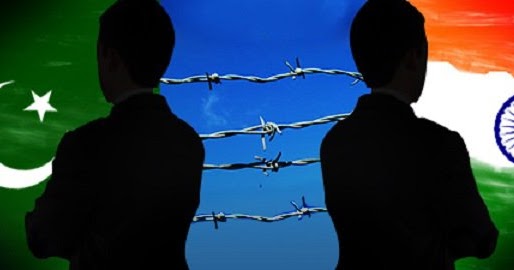
Since its establishment in 1947, Pakistan has been involved in numerous armed conflicts, both domestically and internationally. Historically and presently, the primary focus of its military operations has been on neighboring India, with whom Pakistan has fought four major wars, as well as the Siachen conflict, frequent border skirmishes, and standoffs. The two nations have had a hostile and turbulent relationship since their independence from the United Kingdom and subsequent war over the Himalayan region of Jammu and Kashmir. Both India and Pakistan claim Kashmir in its entirety but have not exercised control over the entire region, which remains divided and contested between the two states by the Line of Control. The Kashmir conflict has seen extensive—albeit unsuccessful—intervention and mediation by the United Nations.
Pakistan has also had a turbulent relationship with neighbouring Afghanistan, characterized by armed border skirmishes and periods of diplomatic tension. The Pakistani government has increased military activity along the Afghanistan–Pakistan border and built a border barrier to crack down on illegal immigration, militancy, and smuggling.
Outside of its home region of South Asia, Pakistan has also engaged in international conflicts in the Middle East and Africa as part of larger coalitions, and remains one of the largest contributors of troops to various United Nations peacekeeping missions. The country was designated as a major non-NATO ally by the United States in 2004, and has participated extensively in the American-led War on Terror following the 9/11 attacks.
List
See also
- Outline of Pakistan military history
- Other military conflicts involving Pakistan:
- Kashmir conflict
- 2001–2002 India–Pakistan standoff
- 2008 Indo-Pakistani standoff
- India–Pakistan border skirmishes (disambiguation)
- Afghanistan–Pakistan skirmishes
- 2017 Afghanistan–Pakistan border skirmish
- 2008–12 Pakistan–United States skirmishes
Notes
References
Sources
- Rashid, Ahmed (2010). Taliban The Power of Militant Islam in Afghanistan and Beyond (Ebook). Yale University Press. ISBN 9780300268997.
- Iqbal, Mehrunisa (1972). "The Insurgency in Ceylon and ITS Repercussions". Pakistan Horizon. 25 (2): 51–66. ISSN 0030-980X. JSTOR 41393126.
- Fathers, Micheal (12 October 2000). "Obituary: Sirimavo Bandaranaike, the world's first woman prime minister". Time Asia. Hong Kong. ISSN 0040-781X. Archived from the original on 17 July 2012. Retrieved 3 November 2018.
- Imran, Muhammad; Senaratne, Bhagya, eds. (2017). Pakistan – Sri Lanka Relations: A Story of Friendship. AR Printers, Islamabad (Pakistan): Institute for Strategic Studies, Research and Analysis (ISSRA), National Defence University, Sector E-9. ISBN 978-969-7671-02-1.
- Riedel, Bruce (2014). What We Won America's Secret War in Afghanistan, 1979?89 (ebook). Brookings Institution Press. ISBN 9780815725855.
- Kiessling, Hein Günter (2016). Faith, Unity, Discipline The Inter-Service-Intelligence (ISI) of Pakistan (Hardcover). Hurst. ISBN 9781849045179.
- Kaur, Kulwant (1985). Pak–Afghanistan Relations. Deep & Deep Publications. ISBN 9780836418040.
- Malik, Hafeez (2016). Soviet–Pakistan Relations and Post-Soviet Dynamics, 1947–92 (ebook). Palgrave Macmillan UK. ISBN 9781349105731.
- Martel, Gordon, ed. (2012). The Encyclopedia of War, 5 Volume Set. Wiley. ISBN 978-1-405-19037-4.
- Leake, Elisabeth (2017). The Defiant Border The Afghan-Pakistan Borderlands in the Era of Decolonization, 1936–1965 (Hardcover). Cambridge University Press. ISBN 9781107126022.
- Jamal, Arif (2009). Shadow War: The Untold Story of Jihad in Kashmir. Melville House. ISBN 978-1-933633-59-6.